// FIELD MANUAL //
First-Person Dungeon Crawler Gameplay Guide
What the genre actually asks of you — grid movement, real-time combat, resource pressure and procedural mazes — explained through the mission parameters of Captive 3000.
By the Captive 3000 team · Published 14 August 2026 · Updated 23 October 2026
What a first-person dungeon crawler is
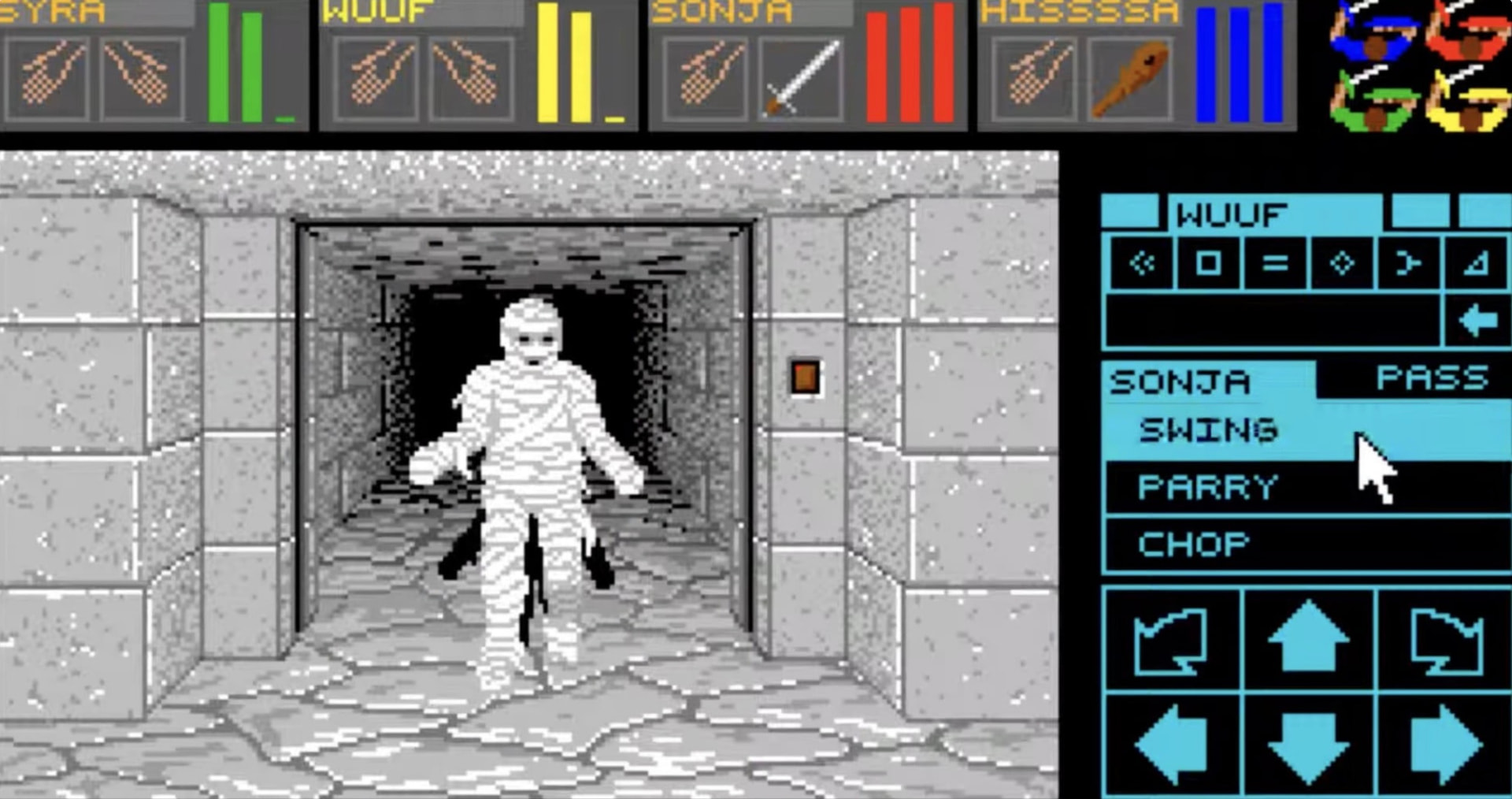
A first-person dungeon crawler puts the camera behind your eyes and drops you into a maze. You do not see your character; you see the corridor ahead, the door to your left, and whatever is walking towards you. The lineage runs from Dungeon Master (1987) through Eye of the Beholder, Black Crypt, Hired Guns and the 1990 Amiga classic Captive, and it is still one of the purest tests of navigation, nerve and inventory discipline in games.
The genre is defined less by graphics than by three rules: movement snaps to a grid, the world is a maze you must map, and every resource you spend is a resource you must find again.
Tile-based movement
You occupy one square tile at a time and face one of four directions. Forward, back, strafe left, strafe right, turn left, turn right. That is the whole vocabulary, and it is deliberately small — because it makes position a decision rather than a reflex.
Practical habits that pay off immediately:
- Turn before you step. Facing costs nothing; walking into an unseen tile can cost everything.
- Strafe, don't rotate, in a fight. Rotating breaks your line of fire; strafing keeps the target in front of you.
- Fight in corridors, not rooms. A corridor lets one enemy reach you at a time. An open room lets four.
- Learn the doorway back-step. Step in, fire, step out. On a grid, the retreat tile is a weapon.
Real-time combat on a grid
Movement is tile-based, but combat does not wait for you. Captive 3000 fields 25 enemy types across dozens of weapons and items, and the tactical layer is entirely about where you are standing when the shooting starts.
Two techniques carry most encounters. The first is dodging — projectiles travel across tiles, so a sidestep is a miss. The second is crossfire manoeuvring: pull two monsters into the same line so their attacks land on each other instead of on you.
Then there is the stalker. It is invulnerable. Nothing in your inventory kills it. The only correct response is distance — route around it, close forcefields behind you, and keep an eye on the minimap to track its location.
Resource management in classic crawlers
Classic dungeon crawlers like Dungeon Master and Eye of the Beholder run on scarcity. Every torch, ration, spell point and healing potion is a decision deferred. The same principle applies in Captive 3000: energy, health, shield, gold, ammo and your nerve all drain as you explore, and replenishing them means finding the right room or returning to a safe point.
- Never enter a new floor on low health or energy.
- Spend currency on survivability before firepower. Dead characters carry no inventory.
- Carry alternate weapons or attack types.
- Clear and loot safely before pushing deeper.
Mapping the maze
Before auto-maps became standard, players of Dungeon Master, Black Crypt and Eye of the Beholder mapped floors by hand on grid paper. Captive 3000 instead provides a comprehensive minimap. Each level is a maze of corridors, rooms, lifts and locked doors, and progress depends on understanding the shape of the space rather than following a waypoint.
- Explore the perimeter of a floor before its interior.
- Note every locked door or inaccessible area and return once you have the key or switch.
- Note ladder and pit locations — they are your escape routes and shortcuts.
- Dead ends often hide the best loot, but they also trap you if you are low on resources.
Procedural generation beyond the singularity
Finish all 13 levels of Mission 01 and the game does not end. The system generates infinite new missions and levels deterministically — fresh mazes, fresh enemy rosters, the same rules. Progress is displayed as mission and level together, so Mission 02 Level 01 reads as M02 L01 on the global leaderboard.
This is the same trick the 1990 original pulled on a 7 MHz machine, and it is why the genre never really ran out of dungeon. There is no final floor — only the next one.
Getting started in a classic dungeon crawler
If you are new to the genre, the first few floors of any classic crawler teach the same habits:
- Don't open new doors until you have cleared the immediate area.
- Fight in corridors, not open rooms — limit how many enemies can reach you at once.
- Strafe and step back rather than standing still.
- Watch your resource meters more closely than your health bar.
- Search dead ends and side corridors for hidden items and shortcuts.
- Save or return to a safe zone whenever you can.
How the classics compare
The genre's core mechanics stayed remarkably stable across three decades. What changed is the setting, the mapping burden and how much dungeon there is.
| Mechanic | Dungeon Master (1987) | Captive (1990) | Captive 3000 |
|---|---|---|---|
| Setting | Fantasy dungeon | Sci-fi prison bases | Sci-fi prison complex |
| Party | Four resurrected heroes | Four remote droids | Single remote droid |
| Movement | Tile-based grid | Tile-based grid | Tile-based grid |
| Combat | Real time | Real time | Real time, 25 enemy types |
| Mapping | Graph paper by hand | In-game map | Comprehensive minimap |
| Levels | 14 handcrafted | Procedural, effectively infinite | 13 handcrafted, then infinite procedural |
| Platform | Atari ST, Amiga | Amiga, Atari ST, DOS | Browser demo, Steam |
Frequently asked questions
- What is a first-person dungeon crawler?
- A first-person dungeon crawler puts the camera behind the player's eyes inside a maze-like dungeon. Movement is usually tile-based on a grid with four facing directions, and progress comes from exploration, combat, and managing limited resources rather than from twitch aiming.
- Is Captive 3000 turn-based or real-time?
- Movement is tile-based but combat runs in real time. Enemies keep closing while you decide, so stepping backwards, sidestepping down a corridor, and reloading at the right moment all matter.
- What is the difference between real-time and turn-based dungeon crawlers?
- In turn-based crawlers such as Wizardry and Etrian Odyssey, the world waits for your input, so every move is a deliberate choice. In real-time grid crawlers such as Dungeon Master, Captive and Captive 3000, movement still snaps tile by tile but enemies act continuously, so timing, retreat routes and luring monsters into crossfire matter as much as planning.
- Are there sci-fi first-person dungeon crawlers?
- Yes. Most of the genre is medieval fantasy, but Captive (1990) and Hired Guns (1993) took grid crawling into science fiction. Captive 3000 continues that line with an abandoned alien-haunted base, energy weapons, shields and remote droid exploration instead of swords and spellbooks.
- How long is Captive 3000?
- Mission 01 contains 13 handcrafted levels of three interconnected floors each and takes about 50-60 hours for the average player. Playtime depends on player skill. After the 13th level the system generates infinite new missions and levels beyond the singularity.
- Can I play the demo for free?
- Yes. The free browser demo at play.captive3000.com includes levels 1 and 2 fully playable, plus level 3 as a timed trial. The full game is on Steam.
Start crawling
Levels 1 and 2 of Mission 01 (plus a timed trial of level 3) run free in your browser — play the demo and put the grid work into practice. The full 13 levels plus infinite missions beyond the singularity are on Steam.
For background on where these mechanics came from, read The History and Legacy of Captive (1990).