// ARCHIVE FILE 1990 //
The History and Legacy of Captive (1990)
Tony Crowther's sci-fi dungeon crawler, its four remote droids and procedurally generated bases — and the inspiration behind Captive 3000.
By the Captive 3000 team · Published 24 June 2026 · Updated 23 October 2026
A signal from 1990
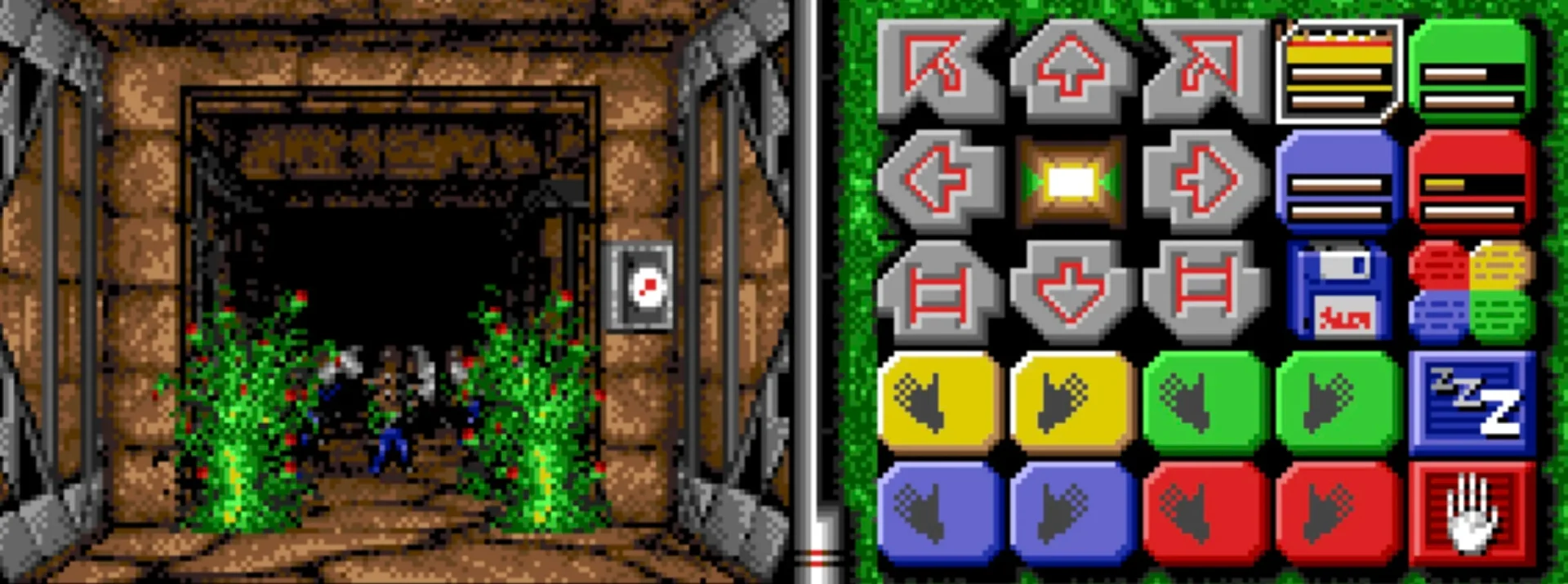
When Mindscape published Captive in 1990 for the Commodore Amiga and Atari ST, the dungeon-crawler genre was dominated by fantasy. FTL's Dungeon Master (1987) had set the template — a party of four heroes, tile-based movement, real-time combat in a first-person grid — and SSI's Eye of the Beholder would lean into the same Tolkien vocabulary the following year. Captive arrived from a different direction entirely: a science-fiction prison break, four cybernetic droids instead of warriors and wizards. Its original description begins with the player waking in prison, finding a briefcase computer, and using remote droids to uncover their identity and escape. [1]
Tony Crowther, alone at the keyboard
The Amiga credits name Antony (Tony) Crowther as coder and designer, and Mindscape as producer. Those credits make Crowther's central role clear without needing to speculate about development time or the tools he used. [1] His combination of first-person exploration, modular droids and generated bases remains the distinctive design at the heart of the game.
Four droids and a briefcase
The opening moments still read as elegant design. You wake in a cell, find a briefcase, and inside it is a small computer that lets you remotely pilot four droids on the surface of a distant planet. The original reference card describes the briefcase controls for up to four droids; the manual explains their equipment, body parts and upgrades. [2] Your party gets stronger by buying and managing equipment rather than following a fantasy character-class system.
Droid power and equipment management create a continuous resource loop. The manual's power and inventory systems make planning part of exploration, not just something to do between fights. [2]
The infinite-levels trick
One of Captive's distinctive ideas was generated bases rather than a fixed set of hand-built dungeon floors. The fan-maintained Atari archive documents its map-generation system and explains that the Amiga and Atari ST versions can generate thousands of missions in theory. [3] [4]That technical archive is a useful guide to the mechanism, not a publisher promise that every possible mission is completable.
Combat in real time, on a grid
Combat inherits the Dungeon Master grid — you face north, south, east or west on a square tile — but it speeds it up. Enemies close on the party in real time. Each droid has its own cooldowns, its own weapons in either hand, its own line of sight. Encounters end quickly and badly if you neglect positioning or equipment. The original manual documents the controls and combat systems. [2]Decades of dungeon crawlers have explored variations on this loop, and Captive's version remains recognisable.
A small, loyal afterlife
Contemporary coverage survives in magazine archives: the Amiga Magazine Rack records an 86% CU Amiga review. [5]The official sequel, Liberation: Captive II, followed on Amiga CD32 in 1993 and Amiga in 1994. [6]These records establish reception and release history without making an unsupported claim about sales.
The surviving Atari technical archive preserves maps, explanations and FAQs for players revisiting the game. [4]Alongside the original manual and preserved reviews, it keeps the game's unusual systems available to a new generation of readers.
From Captive to Captive 3000
Captive 3000 is built directly on that lineage. The tile-based first-person movement, the real-time combat, the constant resource drain, and — most importantly — the infinite deterministically-generated levels that kick in once the hand-authored missions are cleared: all of it is here, rebuilt in a modern browser engine so it runs without an emulator, without a disk swap, and without a 1990 manual. It is an independent spiritual successor, not a sequel or remake, and it deliberately drops the original's complex logistics and inventory management in favour of faster exploration and combat.
What's new is convenience rather than concept. Cloud saves replace floppy juggling. A global leaderboard replaces the high-score sheet taped to the side of a CRT. A free browser demo lets you play levels 1 and 2 (plus a timed trial of level 3) before deciding whether the loop hooks you. But the soul of the thing — the cold sci-fi tone, the sense that the maze is bigger than you are, the briefcase computer commanding bodies you'll never see — that comes straight out of 1990.
If you played Captive on an Amiga 500 and have spent the intervening years quietly hoping someone would pick the thread back up: that's what Captive 3000 is for. The original is worth your time on its own terms — go find a legal copy, fire up an emulator, get annihilated by the first base. Then come back and see what the same signal sounds like in 3000.
Frequently asked questions
- Who made Captive (1990)?
- Captive was created by British developer Tony Crowther and published by Mindscape in 1990 for the Amiga and Atari ST, with later conversions to DOS.
- What made Captive different from other dungeon crawlers?
- Instead of a fantasy party, you remotely control four cybernetic droids from a prison cell. Levels are procedurally generated, so the game offers effectively infinite missions rather than a fixed campaign.
- How many levels does Captive have?
- Captive generates missions procedurally, producing thousands of playable bases rather than a fixed set of hand-built levels.
- Is there a sequel to Captive?
- The official sequel is Liberation: Captive II, released for Amiga CD32 in 1993 and Amiga in 1994. Captive 3000 is not a sequel or remake: it is an independent spiritual successor built from scratch, not affiliated with the original. It shares tile-based first-person movement and real-time combat, offers infinite procedural missions after Mission 01, has a free browser demo, and can be wishlisted on Steam.
Sources and further reading
Original documentation and preserved review records support the historical details above. MobyGames provides credits and release records; the Atari archive is fan-maintained technical documentation.
- MobyGames: Captive — release history, credits and original description
- Captive manual and reference card — preserved by Lemon Amiga
- Captive Atari archive: map-generation technical guide (fan-maintained)
- Captive Atari archive: mission-generation FAQ (fan-maintained)
- Amiga Magazine Rack: contemporary CU Amiga review record
- MobyGames: Liberation — Captive II release history
Continue
Return to Captive 3000 to start the first mission, read the first-person dungeon crawler gameplay guide, or wishlist the full game on Steam.